Thermal Degradation Kinetics and In Vitro Gastrointestinal Stability of 10-Hydroxy-2-Decenoic Acid in Royal Jelly-Based Functional Formulations
- Royal jelly, bee products, 10-HDA degradation, LC-MSMS, in vitro Bioaccessibility, gastrointestinal simulation
Copyright (c) 2026 SCHQ

This work is licensed under a Creative Commons Attribution-NonCommercial-ShareAlike 4.0 International License.
Abstract
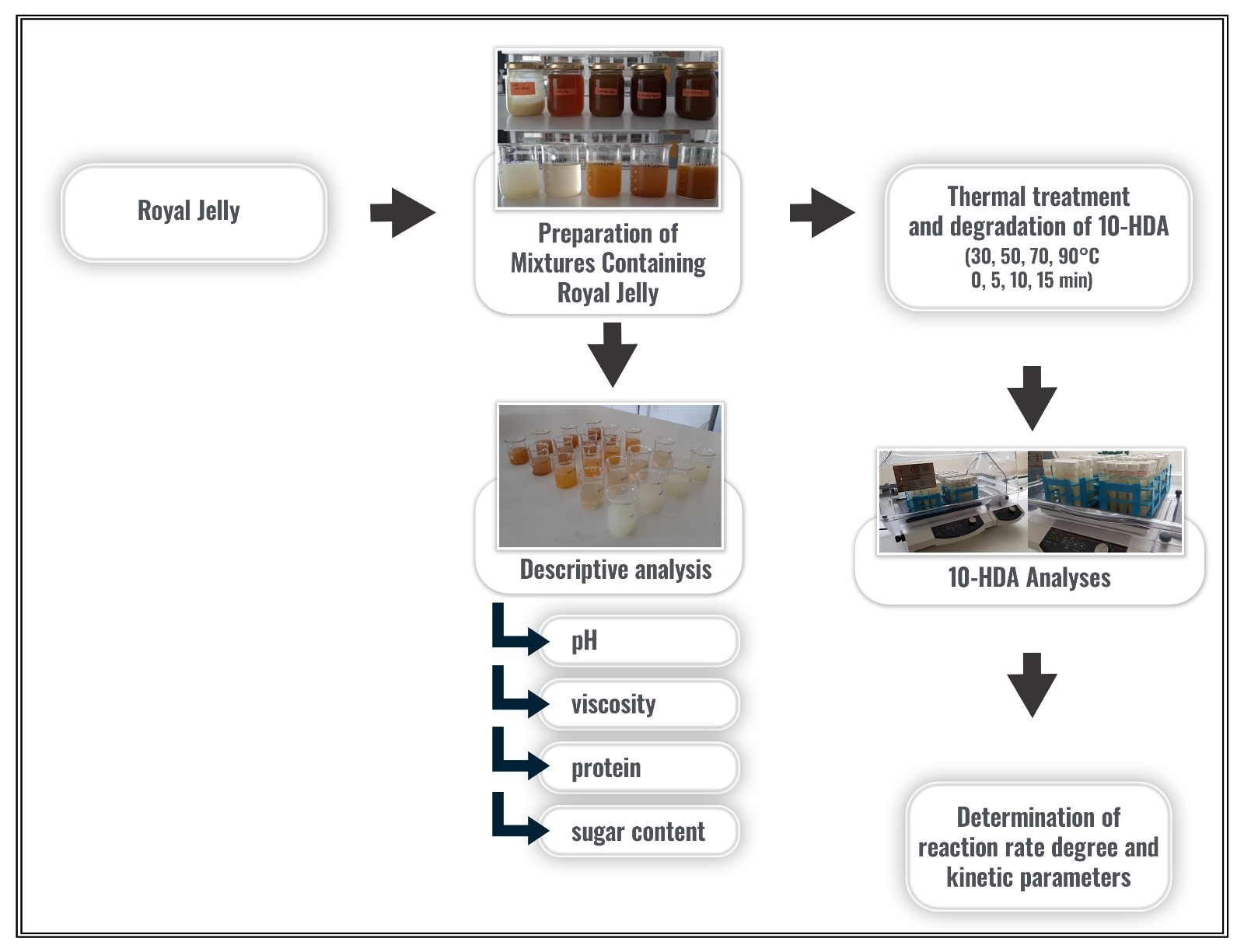
Royal jelly (RJ) is a bee-derived secretion rich in 10-hydroxy-2-decenoic acid (10-HDA), a fatty acid responsible for its antimicrobial, antioxidant, and neuroprotective effects. However, 10-HDA is sensitive to heat and digestive conditions, which limits its stability in functional formulations. This study investigated the thermal degradation kinetics and in vitro gastrointestinal stability of 10-HDA in pure RJ and its mixtures with honey, pollen, and propolis. Samples were thermally treated at 30, 50, 70, and 90 °C for 0–20 minutes. LC-MS/MS analysis showed that in pure RJ, 10-HDA content decreased from 1.905 g/100 g to 0.149 g/100 g at 90 °C, following first-order kinetics with an activation energy of 29,27. In contrast, all mixtures followed zero-order kinetics, suggesting that matrix components provided thermal protection. Calculated activation energies and Q₁₀ values confirmed the compound’s thermal sensitivity. Gastrointestinal stability was assessed using simulated salivary, gastric, and intestinal fluids. The highest degradation occurred in the oral and intestinal phases. The soft candy formulation showed the highest intestinal loss (57.14%), while the RJ- honey-propolis mixture retained the most 10-HDA (31.19 g/100 g). Propolis-containing formulations consistently performed better. In conclusion, 10-HDA degradation is strongly affected by temperature, digestion time, and formulation composition. Propolis and honey enhanced 10-HDA retention, especially under digestive conditions. These findings offer practical insights for developing heat-stable and bioaccessible RJ-based functional products for food, supplement, and apitherapy applications.
References
- Yu, X.; Tu, X.; Tao, L.; Daddam, J.; Li, S.; Foods, F.H.-J. of F.; 2023, undefined Royal Jelly Fatty Acids: Chemical Composition, Extraction, Biological Activity, and Prospect. ElsevierX Yu, X Tu, L Tao, J Daddam, S Li, F HuJournal of Functional Foods, 2023•Elsevier 2023.
- Fuente-Ballesteros, A.; Jano, A.; Bernal, J.; Ares, A.M. Development and Validation of an Analytical Methodology Based on Solvent Extraction and Gas Chromatography for Determining Pesticides in Royal Jelly and Propolis. Food Chem 2024, 437, doi:10.1016/J.FOODCHEM.2023.137911.
- Perminaite, K.; Marksa, M.; Ivanauskas, L.; Ramanauskiene, K. Preparation of Ophthalmic Microemulsions Containing Lithuanian Royal Jelly and Their Biopharmaceutical Evaluation. Processes 2021, 9, doi:10.3390/pr9040616.
- Chen, Y.-F.; Wang, K.; Zhang, Y.-Z.; Zheng, Y.-F.; Hu, F.-L. In Vitro Anti‐Inflammatory Effects of Three Fatty Acids from Royal Jelly. Wiley Online Library 2016, 2016, doi:10.1155/2016/3583684.
- Flanjak, I.; Jakovljević, M.; Kenjerić, D.; Cvijetić Stokanović, M.; Primorac, L.; Bilić Rajs, B. Determination of (2E)-10-Hydroxydec-2-Enoic Acid in Croatian Royal Jelly by High-Performance Liquid Chromatography. Croatian journal of food science and technology 2017, 9, 152–157, doi:10.17508/CJFST.2017.9.2.10.
- Anusha, R.; Research, S.P.-M.N.& F.; 2022, undefined Dietary Exosome‐like Nanoparticles: An Updated Review on Their Pharmacological and Drug Delivery Applications. Wiley Online LibraryR Anusha, S PriyaMolecular Nutrition & Food Research, 2022•Wiley Online Library 2022, 66, doi:10.1002/mnfr.202200142.
- Chen, L.; Ning, F.; Ming, H.; Zhang, J.; Yu, W.; Chemistry, S.Y.-F.; 2023, undefined Quality Assessment of Royal Jelly Based on Physicochemical Properties and Flavor Profiles Using HS-SPME-GC/MS Combined with Electronic Nose And. ElsevierL Chen, F Ning, L Zhao, H Ming, J Zhang, W Yu, S Yi, L LuoFood Chemistry, 2023•Elsevier 2023.
- Isidorov, V.; Czyżewska, U.; B, A.I.-… of C.; 2009, undefined Gas Chromatographic and Mass Spectrometric Characterization of the Organic Acids Extracted from Some Preparations Containing Lyophilized Royal Jelly. Elsevier 2009.
- Isidorov, V.; Bakier, S.; B, I.G.-J. of C.; 2012, undefined Gas Chromatographic–Mass Spectrometric Investigation of Volatile and Extractable Compounds of Crude Royal Jelly. Elsevier 2012.
- Isidorov, V.; Czyżewska, U.; Jankowska, E.; chemistry, S.B.-F.; 2011, undefined Determination of Royal Jelly Acids in Honey. ElsevierVA Isidorov, U Czyżewska, E Jankowska, S BakierFood chemistry, 2011•Elsevier 2011.
- Gasic, S.; Vucevic, D.; Vasilijic, S.; Antunovic, M.; Chinou, I.; Colic, M. Evaluation of the Immunomodulatory Activities of Royal Jelly Components in Vitro. Immunopharmacol Immunotoxicol 2007, 29, 521–536, doi:10.1080/08923970701690977.
- Vucevic, D.; Melliou, E.; Vasilijic, S.; … S.G.-I.; 2007, undefined Fatty Acids Isolated from Royal Jelly Modulate Dendritic Cell-Mediated Immune Response in Vitro. ElsevierD Vucevic, E Melliou, S Vasilijic, S Gasic, P Ivanovski, I Chinou, M ColicInternational immunopharmacology, 2007•Elsevier 2007.
- Mihajlovic, D.; Rajkovic, I.; Chinou, I.; Foods, M.C.-J. of F.; 2013, undefined Dose-Dependent Immunomodulatory Effects of 10-Hydroxy-2-Decenoic Acid on Human Monocyte-Derived Dendritic Cells. ElsevierD Mihajlovic, I Rajkovic, I Chinou, M ColicJournal of Functional Foods, 2013•Elsevier 2013.
- Mihajlovic, D.; Vucevic, D.; Chinou, I.; Colic, M. Royal Jelly Fatty Acids Modulate Proliferation and Cytokine Production by Human Peripheral Blood Mononuclear Cells. European Food Research and Technology 2014, 238, 881–887, doi:10.1007/S00217-014-2154-7.
- Fan, P.; Han, B.; Hu, H.; Wei, Q.; Zhang, X.; Meng, L.; Nie, J.; Tang, X.; Tian, X.; Zhang, L.; et al. Proteome of Thymus and Spleen Reveals That 10-Hydroxydec-2-Enoic Acid Could Enhance Immunity in Mice. Expert Opin Ther Targets 2020, 24, 267–279, doi:10.1080/14728222.2020.1733529.
- Shahla, J.; Dariush, H.; Bijan, S.; Majid, E.; Reports, A.Z.-G.; 2021, undefined Comparative Immunomodulatory Effects of Jelly Royal and 10-H2DA on Experimental Autoimmune Encephalomyelitis. Elsevier 2021.
- Sugiyama, T.; Takahashi, K.; Tokoro, S.; Gotou, T.; Neri, P.; Mori, H. Inhibitory Effect of 10-Hydroxy-Trans-2-Decenoic Acid on LPS-Induced IL-6 Production via Reducing IκB-ζ Expression. journals.sagepub.comT Sugiyama, K Takahashi, S Tokoro, T Gotou, P Neri, H MoriInnate Immunity, 2012•journals.sagepub.com 2012, 18, 429–437, doi:10.1177/1753425911416022.
- Takahashi, K.; Sugiyama, T.; Tokoro, S.; Neri, P.; Immunology, H.M.-C.; 2012, undefined Inhibition of Interferon-γ-Induced Nitric Oxide Production by 10-Hydroxy-Trans-2-Decenoic Acid through Inhibition of Interferon Regulatory Factor-8 Induction. Elsevier 2012.
- Sugiyama, T.; Takahashi, K.; Kuzumaki, A.; Tokoro, S.; Neri, P.; Mori, H. Inhibitory Mechanism of 10-Hydroxy-Trans-2-Decenoic Acid (Royal Jelly Acid) against Lipopolysaccharide- and Interferon-β-Induced Nitric Oxide Production. Inflammation 2013, 36, 372–378, doi:10.1007/S10753-012-9556-0.
- Chen, Y.-F.; Wang, K.; Zhang, Y.-Z.; Zheng, Y.-F.; Hu, F.-L. In Vitro Anti‐Inflammatory Effects of Three Fatty Acids from Royal Jelly. Wiley Online Library 2016, 2016, doi:10.1155/2016/3583684.
- Cai, Q.; Ji, S.; Sun, Y.; Yu, L.; Wu, X.; Foods, Z.X.-J. of F.; 2018, undefined 10-Hydroxy-Trans-2-Decenoic Acid Attenuates Angiotensin II-Induced Inflammatory Responses in Rat Vascular Smooth Muscle Cells. Elsevier 2018.
- Chen, Y.-F.; You, M.-M.; Liu, Y.-C.; Shi, Y.-Z.; Wang, K.; Lu, Y.-Y.; Hu, F.-L. Potential Protective Effect of Trans-10-Hydroxy-2-Decenoic Acid on the Inflammation Induced by Lipoteichoic Acid. Elsevier 2018.
- Yang, Y.-C.; Chou, W.-M.; Widowati, D.A.; Lin, I.-P.; Peng, C.-C. 10-Hydroxy-2-Decenoic Acid of Royal Jelly Exhibits Bactericide and Anti-Inflammatory Activity in Human Colon Cancer Cells. Springer 2018, 18, doi:10.1186/s12906-018-2267-9.
- You, M.; Miao, Z.; Tian, J.; Hu, F. Trans-10-Hydroxy-2-Decenoic Acid Protects against LPS-Induced Neuroinflammation through FOXO1-Mediated Activation of Autophagy. Eur J Nutr 2020, 59, 2875–2892, doi:10.1007/S00394-019-02128-9.
- Huang, S.; Tao, R.; Zhou, J.; Qian, L.; Wu, J.; Huang, S.; Tao, R.; Zhou, J.; Qian, L. Trans 10 Hydroxy 2‐Decenoic Acid Alleviates Dextran Sulfate Sodium‐Induced Colitis in Mice via Regulating the Inflammasome‐Mediated Pyroptotic Pathway And. Wiley Online LibraryS Huang, R Tao, J Zhou, L Qian, J WuMolecular Nutrition & Food Research, 2022•Wiley Online Library 2022, 66, doi:10.1002/mnfr.202100821.
- Park, H.M.; Hwang, E.; Lee, K.G.; Han, S.M.; Cho, Y.; Kim, S.Y. Royal Jelly Protects against Ultraviolet B-Induced Photoaging in Human Skin Fibroblasts via Enhancing Collagen Production. J Med Food 2011, 14, 899–906, doi:10.1089/JMF.2010.1363.
- Zheng, J.; Lai, W.; Zhu, G.; Wan, M.; Chen, J.; Tai, Y.; Lu, C. 10‐Hydroxy‐2‐decenoic Acid Prevents Ultraviolet A‐induced Damage and Matrix Metalloproteinases Expression in Human Dermal Fibroblasts. Wiley Online LibraryJ Zheng, W Lai, G Zhu, M Wan, J Chen, Y Tai, C LuJournal of the European Academy of Dermatology and Venereology, 2013•Wiley Online Library 2013, 27, 1269–1277, doi:10.1111/j.1468-3083.2012.04707.x.
- Kolayli, S.; Sahin, H.; Can, Z.; Yildiz, O.; Malkoc, M.; Asadov, A. A Member of Complementary Medicinal Food: Anatolian Royal Jellies, Their Chemical Compositions, and Antioxidant Properties. journals.sagepub.comS Kolayli, H Sahin, Z Can, O Yildiz, M Malkoc, A AsadovJournal of evidence-based complementary & alternative medicine, 2016•journals.sagepub.com 2016, 21, NP43–NP48, doi:10.1177/2156587215618832.
- Peng, C.; Sun, H.; Lin, I.; Kuo, P.; and, J.L.-B. complementary; 2017, undefined The Functional Property of Royal Jelly 10-Hydroxy-2-Decenoic Acid as a Melanogenesis Inhibitor. Springer 2017, 17, doi:10.1186/s12906-017-1888-8.
- Albalawi, A.E.; Althobaiti, N.A.; Alrdahe, S.S.; Alhasani, R.H.; Alaryani, F.S.; Binmowyna, M.N.; Barbari´cbarbari´c, M.; Brozovic, A.; Lončar, M.B. Anti-Tumor Effects of Queen Bee Acid (10-Hydroxy-2-Decenoic Acid) Alone and in Combination with Cyclophosphamide and Its Cellular Mechanisms against Ehrlich Solid. mdpi.comAE Albalawi, NA Althobaiti, SS Alrdahe, RH Alhasani, FS Alaryani, MN BinMowynaMolecules, 2021•mdpi.com 2021, doi:10.3390/molecules26227021.
- Shehri, Z.S. Al; Alanazi, A.; Molecules, S.A.-; 2023, undefined Anti-Cancer Effects of Queen Bee Acid (10-Hydroxy-2-Decenoic Acid) and Its Cellular Mechanisms against Human Hepatoma Cells. mdpi.com 2023, doi:10.3390/molecules28041972.
- Yamashita, Y.; Bowen, W.H.; Burne, R.A.; Kuramitsu, H.K. Role of the Streptococcus Mutans Gtf Genes in Caries Induction in the Specific-Pathogen-Free Rat Model. Infect Immun 1993, 61, 3811–3817, doi:10.1128/IAI.61.9.3811-3817.1993.
- Li, S.; Jiang, Z.; Thamm, L.; Zhou, G. 10-Hydroxy-2-Decenoic Acid as an Antimicrobial Agent in Draft Keg-Conditioned Wheat Beer. Journal of the American Society of Brewing Chemists 2010, 68, 114–118, doi:10.1094/ASBCJ-2010-0303-01.
- Yousefi, B.; Ghaderi, S.; Rezapoor-Lactooyi, A.; Amiri, N.; Verdi, J.; Shoae-Hassani, A. Hydroxy Decenoic Acid down Regulates GtfB and GtfC Expression and Prevents Streptococcus Mutans Adherence to the Cell Surfaces. Springer 2012, 11, doi:10.1186/1476-0711-11-21.
- Caparica-Santos, C.; Marcucci, M.C. Quantitative Determination of Trans- 10-Hydroxy-2-Decenoic Acid (10-HDA) in Brazilian Royal Jelly and Commercial Products Containing Royal Jelly. J Apic Res 2007, 46, 149–153, doi:10.1080/00218839.2007.11101386.
- Kamakura, M.; Fukuda, T.; … M.F.-B.; 2001, undefined Storage-Dependent Degradation of 57-KDa Protein in Royal Jelly: A Possible Marker for Freshness. academic.oup.comM Kamakura, T Fukuda, M Fukushima, M YoNEKURABioscience, biotechnology, and biochemistry, 2001•academic.oup.com 2014, 65, 277–284, doi:10.1271/bbb.65.277.
- e Silva, T.G. de S.; da Silva, J.R.M.; da Silva Alves, A.; Britto, L.R.G.; Xavier, G.F.; Sandoval, M.R.L. Oral Treatment with Royal Jelly Improves Memory and Presents Neuroprotective Effects on Icv-STZ Rat Model of Sporadic Alzheimer’s Disease. Heliyon 2020, 6.
- Wang, C.; Jiang, Z.; Wang, J.; Lou, J.; Nian, Y.; Liu, L.; Dang, T.; Meng, X. A Small H2O-Soluble Ingredient of Royal Jelly Lower Cholesterol Levels in Liver Cells by Suppressing Squalene Epoxidase. Heliyon 2022, 8.
- Gérez, N.; Pérez-Parada, A.; Cesio, M.; Control, H.H.-F.; 2017, undefined Occurrence of Pesticide Residues in Candies Containing Bee Products. Elsevier 2017.
- Ahmad, S.; Campos, M.; Fratini, F.; … S.A.-I. journal of; 2020, undefined New Insights into the Biological and Pharmaceutical Properties of Royal Jelly. mdpi.comS Ahmad, MG Campos, F Fratini, SZ Altaye, J LiInternational journal of molecular sciences, 2020•mdpi.com 2020, doi:10.3390/ijms21020382.
- Antinelli, J.; Zeggane, S.; Davico, R.; chemistry, C.R.-F.; 2003, undefined Evaluation of (E)-10-Hydroxydec-2-Enoic Acid as a Freshness Parameter for Royal Jelly. ElsevierJF Antinelli, S Zeggane, R Davico, C Rognone, JP Faucon, L LizzaniFood chemistry, 2003•Elsevier 2003.
- Garcia-Amoedo, L.; Nova, L.A.-M.-Q.; 2007, undefined Physicochemical Composition of Pure and Adulterated Royal Jelly. SciELO BrasilLH Garcia-Amoedo, LB Almeida-MuradianQuímica Nova, 2007•SciELO Brasil 2007, 30, 257–259.
- Rzetecka, N.; Matuszewska, E.; … S.P.-J. of F.; 2024, undefined Bee Products as Valuable Nutritional Ingredients: Determination of Broad Free Amino Acid Profiles in Bee Pollen, Royal Jelly, and Propolis. Elsevier 2024.
- Saricaoglu, F.T.; Cinar, A.; Demircan, H.; Oral, R.A. Rheological and Microstructural Characterization of Royal Jelly at Different Temperatures. J Food Process Eng 2019, 42, doi:10.1111/JFPE.13285.
- Végh, R.; Csóka, M.; … C.S.-C.R. in; 2024, undefined Underexplored Food Safety Hazards of Beekeeping Products: Key Knowledge Gaps and Suggestions for Future Research. Wiley Online LibraryR Végh, M Csóka, C Sörös, L SiposComprehensive Reviews in Food Science and Food Safety, 2024•Wiley Online Library 2024, 23, doi:10.1111/1541-4337.13404.
- Wytrychowski, M.; Païssé, J.; … H.C.-I.C. and; 2014, undefined Assessment of Royal Jelly Freshness by HILIC LC–MS Determination of Furosine. ElsevierM Wytrychowski, JO Païssé, H Casabianca, G DanieleIndustrial Crops and Products, 2014•Elsevier 2014.
- Chen, L.; Remondetto, G.E.; Subirade, M. Food Protein-Based Materials as Nutraceutical Delivery Systems. Trends Food Sci Technol 2006, 17, 272–283.
- Salsinha, A.; Cunha, S.; Bioscience, M.M.-F.; 2023, undefined Assessment of the Bioaccessibility and Bioavailability Prediction of Omega 3 and Conjugated Fatty Acids by in Vitro Standardized Digestion Model (INFOGEST). ElsevierAS Salsinha, SA Cunha, M Machado, LM Rodríguez-Alcalá, JB Relvas, M PintadoFood Bioscience, 2023•Elsevier 2023.
- Gervais, R.; Gagnon, F.; … E.K.-I. dairy; 2009, undefined Bioaccessibility of Fatty Acids from Conjugated Linoleic Acid-Enriched Milk and Milk Emulsions Studied in a Dynamic in Vitro Gastrointestinal Model. Elsevier.
- Hacıoğlu, A. Stevia (Stevia Rebaudiana B.) Bitkisi Ekstraktı Kullanılarak Enerjisi Düşürülmüş Yumuşak Şeker Üretimi. Akdeniz University 2017, 138.
- Edwards, W.P. The Science of Sugar Confectionery; Royal Society of Chemistry, 2018; ISBN 1788011333.
- Witzler, J.J.P.; Pinto, R.A.; de Valdez, G.F.; de Castro, A.D.; Cavallini, D.C.U. Development of a Potential Probiotic Lozenge Containing Enterococcus Faecium CRL 183. LWT 2017, 77, 193–199.
- Kadakal, çetin; Nas, S. Effect of Heat Treatment and Evaporation on Patulin and Some Other Properties of Apple Juice. J Sci Food Agric 2003, 83, 987–990, doi:10.1002/jsfa.1339.
- Marconi, E.; Caboni, M.F.; Messia, M.C.; Panfili, G. Furosine: A Suitable Marker for Assessing the Freshness of Royal Jelly. J Agric Food Chem 2002, 50, 2825–2829, doi:10.1021/JF0114987.
- Miller, G.L. Use of Dinitrosalicylic Acid Reagent for Determination of Reducing Sugar. Anal Chem 1959, 31, 426–428, doi:10.1021/ac60147a030.
- Ferioli, F.; Marcazzan, G.L.; Caboni, M.F. Determination of (E)‐10‐hydroxy‐2‐decenoic Acid Content in Pure Royal Jelly: A Comparison between a New CZE Method and HPLC. Wiley Online LibraryF Ferioli, GL Marcazzan, MF CaboniJournal of separation Science, 2007•Wiley Online Library 2007, 30, 1061–1069, doi:10.1002/jssc.200600416.
- Samtlebe, M.; Ergin, F.; Wagner, N.; Neve, H.; Küçükçetin, A.; Franz, C.M.A.P.; Heller, K.J.; Hinrichs, J.; Atamer, Z. Carrier Systems for Bacteriophages to Supplement Food Systems: Encapsulation and Controlled Release to Modulate the Human Gut Microbiota. LWT-Food Science and Technology 2016, 68, 334–340.
- Kim, E.; Jang, M.; Jeong, H.; Kim, Y.; Shin, Y.; Park, J.; Lee, J.; Cho, S.; Hwang, I.; Shin, Y. Changes in the Chemical Composition of Royal Jelly Produced through Artificial Bee-Feeding in Response to Seasonal Variations during Non-Migratory Beekeeping. Journal of Food Composition and Analysis 2023, 115, 104982, doi:10.1016/J.JFCA.2022.104982.
- Alattal, Y.Z.; Bazeyad, A.Y.; Al Ghamdi, A.A. Variation in Chemical Composition of Fresh and Commercial Royal Jelly Associated with International Standards. Journal of Food Composition and Analysis 2025, 138, 107017, doi:https://doi.org/10.1016/j.jfca.2024.107017.
- Aylanc, V.; Falcão, S.I.; Vilas-Boas, M. Bee Pollen and Bee Bread Nutritional Potential: Chemical Composition and Macronutrient Digestibility under in Vitro Gastrointestinal System. Food Chem 2023, 413, 135597, doi:10.1016/J.FOODCHEM.2023.135597.
- Soylu, P.; Bayram, B.; Üniversitesi Mühendislik ve Doğa Bilimleri Fakültesi Gıda Mühendisliği Bölümü, G.; Üniversitesi Ziraat Fakültesi Zootekni Bölümü, A. Bal, Propolis, Arı Sütü, Çivanperçemi (Achillea Millefolium) ve Ekinezya (Echinacea Paradoxa) Karışımından Fonksiyonel Gıda Üretimi, Ürünün Fizikokimyasal Ve. dergipark.org.trP Soylu, B BayramBahri Dağdaş Hayvancılık Araştırma Dergisi, 2020•dergipark.org.tr 2020, 9, 2687–3745.
- Yavuz, İ.; Gürel, F. Chemical Properties of the Royal Jellies in Turkish Markets. 2017, 30, 281–285, doi:10.29136/mediterranean.360013.
- International Organization for Standardization ISO/DIS 12824:2016. Royal Jelly – Specifications 2016.
- Bloodworth, B.C.; Harn, C.S.; Hock, C.T.; Boon, Y.O. Liquid Chromatographic Determination of Trans-10-Hydroxy-2-Decenoic Acid Content of Commercial Products Containing Royal Jelly. J AOAC Int 1995, 78, 1019–1023.
- Ghadimi‐Garjan, R.; … A.J.-F.S.&; 2023, undefined Lyophilized Royal Jelly Preparation in Nanoscale and Evaluation of Its Physicochemical Properties and Bactericidal Activity. Wiley Online LibraryR Ghadimi‐Garjan, A Javadi, H Jafarizadeh‐Malmiri, N Anarjan, H MirzaeiFood Science & Nutrition, 2023•Wiley Online Library 2023, 11, 3404–3413, doi:10.1002/fsn3.3330.
- Karhan, M.; Aksu, M.; Tetik, N.; Turhan, I. Kinetic Modeling of Anaerobic Thermal Degradation of Ascorbic Acid in Rose Hip (Rosa Canina L) Pulp. J Food Qual 2004, 27, 311–319.
- Ceribeli, C.; Otte, J.; Cardoso, D.R.; Ahrné, L.M. Kinetics of Vitamin B12 Thermal Degradation in Cow’s Milk. J Food Eng 2023, 357, 111633, doi:10.1016/J.JFOODENG.2023.111633.
- Sangaré, D.; Yee Chung, K.W.; Blin, J.; Lanvin, C.; Valette, J.; De Steene, L. Van Thermal Degradation and Reactivity of Cashew Nut Shell Liquid Constituents. Chemical Engineering Journal 2025, 507, 160866, doi:10.1016/J.CEJ.2025.160866.
- Zeb, A. Concept, Mechanism, and Applications of Phenolic Antioxidants in Foods. J Food Biochem 2020, 44, doi:10.1111/JFBC.13394.
- Baştürk, A.; Science, B.Y.-J. of F.; 2024, undefined Improving Sunflower Oil Stability with Propolis: A Study on Antioxidative Effects of Turkish Propolis during Accelerated Oxidation. Wiley Online LibraryA Baştürk, B YavaşJournal of Food Science, 2024•Wiley Online Library 2024, doi:10.1111/1750-3841.17482.
- Martinello, M.; Mutinelli, F.; Zooprofilattico, I.; Delle Venezie, S. Antioxidant Activity in Bee Products: A Review. mdpi.comM Martinello, F MutinelliAntioxidants, 2021•mdpi.com 2021, doi:10.3390/antiox.
- Vojvodi´c, A.; Cebin, V.; Buni´cbuni´c, M.; Mandura, A.; Jari´c, J.; Šeremet, D.; Komes, D. Physicochemical and Sensory Stability Evaluation of Gummy Candies Fortified with Mountain Germander Extract and Prebiotics. mdpi.comA Vojvodić Cebin, M Bunić, A Mandura Jarić, D Šeremet, D KomesPolymers, 2024•mdpi.com 2024, doi:10.3390/polym16020259.